The average IQ is 100 at every age, from a 5-year-old to a 90-year-old, because every modern IQ test compares you only with people of your own age. What changes with age is the raw performance behind that 100, and it changes differently for different abilities: processing speed peaks in the late teens, working memory in the 20s, and vocabulary not until about 50 to 65. The table and chart below show both, with the published sources for every figure.
“What is the average IQ for my age?” has a short answer and a more interesting one. The short answer is 100, whatever your age. The interesting one is what that 100 hides: a 25-year-old and a 75-year-old who both score 100 did not give the same answers, and the abilities that make up an IQ score rise and fall on very different schedules.
Average IQ by age: the table
IQ tests are age-normed. When a test is built, the publisher tests a large sample of people in each age band and sets the scale so that the average of every band is 100 and the standard deviation is 15. Your score is then your position within your own band. That is why the average cannot change with age: it is fixed at 100 by design.
| Age | Average IQ | Middle 68% of people | Tests normed for this age |
|---|---|---|---|
| 2–5 | 100 | 85–115 | WPPSI-IV (from 2 years 6 months), Stanford-Binet 5 |
| 6–11 | 100 | 85–115 | WISC-V, Stanford-Binet 5 |
| 12–15 | 100 | 85–115 | WISC-V, Stanford-Binet 5 |
| 16–19 | 100 | 85–115 | WAIS-IV / WAIS-5 (from 16), WISC-V (to 16 years 11 months), Stanford-Binet 5 |
| 20–34 | 100 | 85–115 | WAIS-IV / WAIS-5, Stanford-Binet 5 |
| 35–54 | 100 | 85–115 | WAIS-IV / WAIS-5, Stanford-Binet 5 |
| 55–69 | 100 | 85–115 | WAIS-IV / WAIS-5, Stanford-Binet 5 |
| 70–84 | 100 | 85–115 | WAIS-IV / WAIS-5, Stanford-Binet 5 |
| 85–90 | 100 | 85–115 | WAIS-IV / WAIS-5, Stanford-Binet 5 (85 and over) |
Middle 68% = within one standard deviation of the mean (100 ± 15). Age ranges as published: WPPSI-IV 2:6–7:7, WISC-V 6:0–16:11, WAIS-IV and WAIS-5 16:0–90:11, Stanford-Binet 5 ages 2 to 85+.
The bands inside a test are narrower than this table. The WAIS-IV was normed on 2,200 people in the United States split into 13 age groups: 16–17, 18–19, 20–24, 25–29, 30–34, 35–44, 45–54, 55–64, 65–69, 70–74, 75–79, 80–84 and 85–90. A 72-year-old is compared with the 70–74 group only. The WAIS-5 (2024) was normed again on a new sample aged 16 to 90.
Why the same IQ means different answers at 10, 30 and 75
Because each age band has its own average, the number of questions you need to answer correctly for an IQ of 100 is different at different ages. A 10-year-old reaches 100 with far fewer correct answers than a 30-year-old on the same kind of test. In adulthood the shift depends on the task: on timed tasks such as digit-symbol coding, older bands need fewer correct answers for the same score, while on vocabulary, middle-aged bands need more correct answers than young adults do.
So an IQ score always answers one question: how do you compare with people your own age? It does not say whether you would beat a 25-year-old on a speed task. Early tests worked differently and expressed a child’s level as a mental age; the age-normed deviation IQ replaced that because a ratio of mental to real age stops making sense in adulthood. How the raw score turns into a percentile on the 100/15 scale is in our IQ percentile chart.
When each ability peaks
The clearest map of “what changes” comes from Joshua Hartshorne and Laura Germine (2015, Psychological Science). They re-analysed the published norms of the WAIS-III and WMS-III and tested more than 10,000 people aged 10 to about 70 in each of their online experiments. Their conclusion: there is no single age at which people are at their best on all, or even most, cognitive tasks.
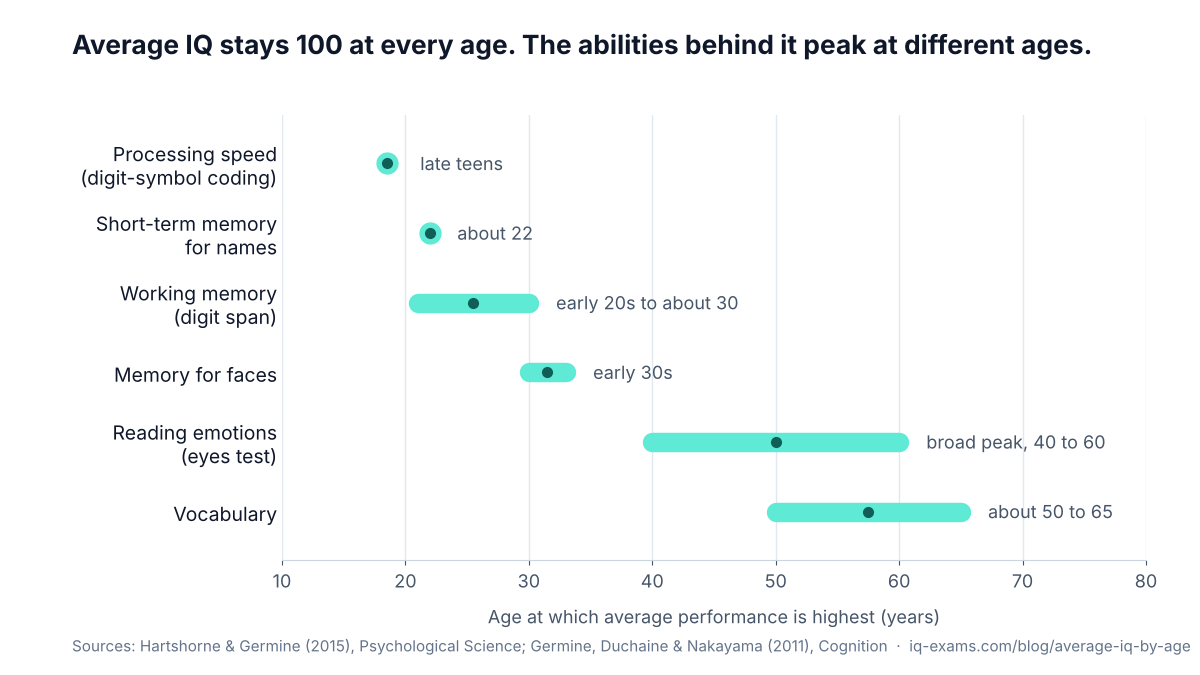
| Ability (task) | Approximate peak | Source |
|---|---|---|
| Processing speed (digit-symbol coding) | Late teens | Hartshorne & Germine 2015, WAIS-III norms and online data |
| Short-term memory for names | About 22 | Germine et al. 2011, as reported by Hartshorne & Germine 2015 |
| Working memory (digit span) | Early 20s (WAIS-III norms) to about 30 (online data) | Hartshorne & Germine 2015 |
| Memory for faces | Early 30s | Germine, Duchaine & Nakayama 2011, Cognition |
| Reading emotions (“Reading the Mind in the Eyes”) | Broad peak, about 40 to 60 | Hartshorne & Germine 2015 |
| Vocabulary | About 50 (WAIS-III norms) to about 65 (online data) | Hartshorne & Germine 2015 |
The pattern fits the older split between fluid and crystallized intelligence: reasoning and speed with new material peak early, knowledge keeps growing. But Hartshorne and Germine also show it is messier than two curves. Working memory and face memory peak later than processing speed, and the vocabulary peak has moved later in more recent generations, by roughly one year for every year later the data were collected, which suggests people keep learning words for longer than they used to.
Does IQ go down with age?
Your IQ score usually does not, because the norms move with you. The raw abilities behind it are another matter, and the answer depends on how you measure.
Comparing age groups (cross-sectional). When people of different ages take the same test at the same time, older groups score lower on speed, working memory and reasoning, and the differences start early. Timothy Salthouse (2009, Neurobiology of Aging) concluded that some aspects of age-related cognitive decline begin in healthy, educated adults in their 20s and 30s.
Following the same people (longitudinal). Studies that retest the same people over decades, such as K. Warner Schaie’s Seattle Longitudinal Study (started in 1956), tend to show later and smaller declines. Part of the gap is that people get better at a test they have seen before, and part is generational: older cohorts grew up with less schooling, so a cross-sectional comparison mixes ageing with history.
Both lines of evidence agree on the shape: knowledge and vocabulary hold up best, speed declines first, and differences between individuals grow with age. Some people in their 80s still outscore the average 30-year-old on raw performance; others decline much earlier.
How stable is one person’s IQ over a lifetime?
More stable than most people expect. In the follow-up of the 1932 Scottish Mental Survey, Ian Deary and colleagues (2000, Intelligence) retested people at age 77 on the same test (the Moray House Test) they had taken at age 11. The correlation between the two scores was 0.63, and the authors note that this raw figure underestimates the true stability because the retested group was less varied than the 1932 cohort. In plain terms: where you stood among your classmates at 11 says a good deal about where you stand among people your age at 77, but far from everything.
Scores in early childhood are the least stable. A score from a preschool test predicts adult IQ much less well than one from late childhood or adolescence, which is one reason psychologists retest children rather than rely on one early result.
The generation effect: why older norms inflate scores
The averages also drift between generations. The largest analysis, Jakob Pietschnig and Martin Voracek’s meta-analysis of 271 samples from 1909 to 2013 (2015, Perspectives on Psychological Science), estimated gains of 0.28 full-scale IQ points a year (about 2.8 points per decade), with larger gains on fluid tasks (0.41 a year) than on crystallized ones (0.21 a year). In Norway the trend reversed for men born after about 1975, and Bernt Bratsberg and Ole Rogeberg (2018, PNAS) showed the decline appears within families, which points to environmental causes.
For “average IQ by age” this matters in one practical way: a test scored on norms collected years ago compares you with an earlier generation, which tends to make scores look higher than they are. That is why publishers renorm their tests, as the WAIS-5 did in 2024. More in the Flynn effect explained.
What helps cognition hold up with age
Nothing on this list changes your age-normed IQ overnight, but several factors are linked to how well thinking holds up later in life. The 2024 report of the Lancet Commission on dementia prevention (Livingston et al.) names 14 modifiable risk factors and estimates that around 45% of dementia cases are potentially preventable by addressing them: less education, hearing loss, high LDL cholesterol, depression, traumatic brain injury, physical inactivity, diabetes, smoking, high blood pressure, obesity, excessive alcohol, social isolation, air pollution and untreated vision loss.
If you are worried about changes in memory or thinking rather than curious about a number, an IQ score is the wrong tool. Read about the early signs of cognitive decline, and talk to a doctor. Our MoCA-style cognitive screening is an online alternative to the clinical MoCA for a first look; it is not a diagnosis.
Method, sources and how to cite this page
Method. The averages in the first table are not measured from test-takers: they are 100 by definition of age-normed IQ scores (mean 100, SD 15 within each age band), and the 68% range is 100 ± 1 SD. Age ranges are the published ranges of each test. Every other figure on this page is taken from the named study; peak ages are approximate, as the studies report them.
Sources. Wechsler (2008), WAIS-IV; Wechsler (2014), WISC-V; Wechsler (2012), WPPSI-IV; Roid (2003), Stanford-Binet Intelligence Scales, Fifth Edition; WAIS-5 (2024). Hartshorne, J. K., & Germine, L. T. (2015). When does cognitive functioning peak? Psychological Science, 26(4), 433–443. Germine, L. T., Duchaine, B., & Nakayama, K. (2011). Where cognitive development and aging meet: Face learning ability peaks after age 30. Cognition, 118(2). Salthouse, T. A. (2009). When does age-related cognitive decline begin? Neurobiology of Aging, 30(4), 507–514. Deary, I. J., Whalley, L. J., Lemmon, H., Crawford, J. R., & Starr, J. M. (2000). The stability of individual differences in mental ability from childhood to old age. Intelligence, 28(1). Pietschnig, J., & Voracek, M. (2015). One century of global IQ gains. Perspectives on Psychological Science, 10(3). Bratsberg, B., & Rogeberg, O. (2018). Flynn effect and its reversal are both environmentally caused. PNAS, 115(26), 6674–6678. Livingston, G., et al. (2024). Dementia prevention, intervention, and care: 2024 report of the Lancet standing Commission. The Lancet.
How people who take an online IQ test actually score is a different question from the population norms above; our 2026 data study of 3,834 completed tests describes our own self-selected online sample, not the population.
Frequently asked questions
What is the average IQ for a 10-year-old or a 13-year-old?
100. Children’s tests such as the WISC-V are normed in narrow age bands, so the average child of any age scores 100, and about two in three children score between 85 and 115.
At what age is IQ highest?
Age-normed IQ has no peak: the average is 100 at every age. Raw abilities do peak, at different ages: processing speed in the late teens, working memory in the 20s to about 30, vocabulary at about 50 to 65 (Hartshorne & Germine, 2015).
Does IQ decrease with age?
The age-normed score usually stays fairly stable, because you are compared with people your own age. Raw speed, working memory and reasoning do decline on average from early adulthood, while vocabulary and knowledge hold up into later life.
Is an IQ of 100 at 70 the same as an IQ of 100 at 25?
It is the same position within your own age group, the 50th percentile, but not the same raw performance. On timed tasks the 70-year-old needs fewer correct answers for 100; on vocabulary, typically as many or more.
Can a child’s IQ change?
Yes, especially in early childhood, when scores are least stable. From late childhood on, rank order is fairly stable: scores at age 11 and 77 correlated 0.63 in the Scottish Mental Survey follow-up (Deary et al., 2000).
Where do you stand among people your age?
The test is free to take and needs no account to start. See where you stand.
Take the Free IQ Test